
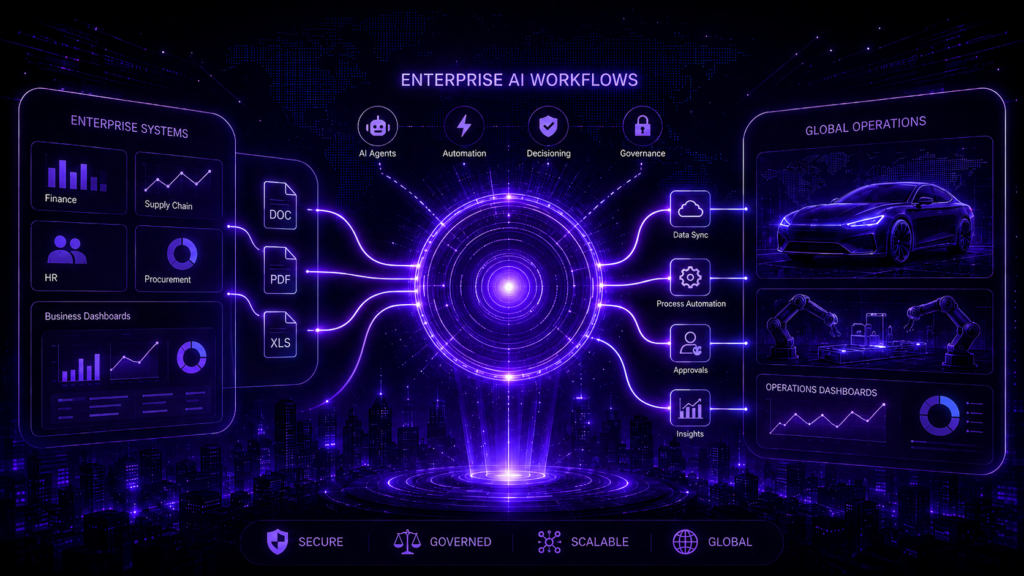
Enterprise AI has moved past the chatbot phase. The real question now is not whether AI can answer questions. The real question is whether AI can become part of how a company actually works.
That is where n8n has started to matter.
n8n is a workflow automation platform that helps teams connect apps, APIs, databases, AI models, and business systems into working processes. It is visual enough for business teams to understand, but flexible enough for engineers to build on. n8n describes its platform as combining visual workflow building with custom code, native AI capabilities, the option to run it in your own environment, and more than 400 integrations. [1]
But the more interesting story is not just what n8n can do. It is who is now using it.
Two recent developments say a lot about where enterprise AI is heading. SAP has made a strategic investment in n8n and plans to embed it into Joule Studio. Mercedes Benz has announced a global rollout of n8n as part of its AI automation strategy. [2] [3]
These are not small experiments. They are signals from large organizations that workflow automation is becoming a serious part of enterprise AI infrastructure.
What SAP Is Doing and Why It Matters
SAP sits at the heart of many large companies. Finance, procurement, supply chain, HR, production, reporting, and other core processes often depend on SAP systems. That makes SAP one of the most important places where AI could create real business value.
But there is a catch.
The hard part is not the AI model itself. A language model can read a document, summarize a message, or suggest a next step. The harder part is connecting that output to the right business data, the right permissions, the right approvals, the right people, and the right system updates.
That is why the SAP and n8n connection is important.
SAP has said that n8n will be embedded into Joule Studio, its environment for building enterprise agents, applications, and agentic workflows. SAP describes Joule Studio as a place where teams can build and orchestrate enterprise AI workflows in a governed environment. [4]
n8n adds the workflow layer. According to n8n, its visual workflow canvas will be brought into Joule Studio on SAP Business Technology Platform. The idea is that teams can orchestrate AI workflows across SAP and third party services while using SAP identity, security, and access controls. [5]
That changes the role of AI inside a business.
Instead of asking an AI assistant for advice and then manually doing the work, a company can build a workflow where AI reads an incoming request, checks SAP data, asks for human approval when needed, and updates the correct record.
That is a much more practical version of enterprise AI.
What This Could Look Like in Practice
Imagine a procurement request arriving by email. A workflow could read the message, extract the important details with AI, check supplier or contract data in SAP, route the request to the right person, and create a follow up task.
In finance, a workflow could help handle invoices. It could extract data from a document, compare it with SAP records, flag exceptions, and send uncertain cases for approval.
In field service, a customer message could trigger a workflow that classifies the issue, retrieves asset information from SAP, checks spare part availability, and notifies the right service team.
In each case, n8n does not replace SAP. That is not the point. The value is that n8n can act as an orchestration layer around SAP. It helps connect SAP data with AI, external tools, and human decisions.
That is where automation becomes useful. Not as a separate tool, but as part of the process.
Mercedes Benz Shows the Scale of the Shift
The Mercedes Benz story gives the same message from a different angle.
Many companies are still stuck in the pilot stage with AI. They test tools, build demos, and try a few internal use cases. Some of those pilots are impressive, but they often never become part of everyday work.
Mercedes Benz is taking a more serious approach.
The company says it is rolling out n8n globally as part of its long term digital and AI strategy. The goal is to move AI automation beyond individual pilots and into everyday business operations across R and D, production, sales, financial services, HR, and IT. [3]
That is the important part. Mercedes Benz is not presenting n8n as a side experiment. It is using it as part of a broader technology stack for AI powered workflows across existing systems. [3]
According to n8n, Mercedes Benz also used a company wide hackathon involving more than 1,500 employees to identify practical AI automation use cases. That detail matters because it shows how enterprise AI can become more grounded. The best automation ideas often come from the people who know the work best. [6]
What Mercedes Benz Gets Right
There are three useful lessons in the Mercedes Benz approach.
First, start with real work. The best automation ideas usually come from repetitive tasks, slow handovers, manual data entry, scattered information, and process bottlenecks. That is where AI can remove friction.
Second, think in platforms, not isolated tricks. One automation can save time. A shared automation platform can create a repeatable way to improve work across departments.
Third, involve the business. The people closest to the process usually know where time is lost. A visual workflow tool gives them a way to explain, test, and shape automations without everything becoming a long software project.
That does not mean everyone should build critical automations without control. It means companies need a model where business teams can contribute and technical teams can keep the system safe, reliable, and maintainable.
The Bigger Point: AI Needs Workflow Infrastructure
SAP and Mercedes Benz are pointing toward the same conclusion.
AI needs workflow infrastructure.
A chatbot can answer a question. A workflow can complete a process.
For AI to become truly useful inside a company, it has to connect with systems, data, approvals, events, and actions. It needs to know where information comes from, what rules apply, what should happen next, and when a human should be involved.
That is why workflow orchestration is becoming so important. The future of enterprise AI is not only about smarter models. It is also about connecting those models to the real machinery of the business.
This is where n8n has found a useful position. It is not only a simple automation tool, and it is not only a developer platform. It sits somewhere between the two. Business teams can understand the logic visually, while engineers can still extend it when needed.
That balance is difficult to get right. It is also probably one reason why SAP and Mercedes Benz are paying attention.
What This Means for Companies Evaluating AI Automation
For companies looking at AI automation, the starting point should not be the tool. It should be the process.
A good first project could be invoice handling, service request classification, sales request processing, internal reporting, document analysis, or customer communication. The best place to begin is usually a process that is repetitive, time consuming, and dependent on information from several systems.
If your organization uses SAP, the SAP and n8n development is especially relevant. It points toward a future where AI workflows can be designed closer to the systems where business critical data already lives.
If your organization does not use SAP, the same idea still applies. The opportunity is to connect AI with ERP, CRM, email, SharePoint, Teams, databases, service systems, and other operational tools.
The real value is not replacing people. It is removing unnecessary manual work, speeding up response times, reducing errors, and giving people more time for decisions that actually need human judgment.
Conclusion
n8n is becoming relevant because it answers one of the biggest questions in enterprise AI: how do you turn AI from a tool into part of the workflow?
SAP’s investment and Joule Studio plans show that n8n is moving closer to core enterprise systems and governed AI processes. Mercedes Benz’s global rollout shows that large organizations are looking for ways to scale AI automation across real business operations.
Together, these developments send a clear message. The next phase of AI will not be defined only by better models. It will be defined by how well those models are connected to systems, people, data, and processes.
That is the shift SAP and Mercedes Benz are already making, and it is likely that many other organizations will follow.
[1] n8n GitHub profile, platform description with native AI capabilities and more than 400 integrations.
[2] n8n announcement about SAP’s strategic investment and plans to embed n8n inside Joule Studio.
[4] SAP article about Joule Studio and enterprise scale agentic development.
[5] n8n article about the SAP partnership and visual AI workflow orchestration in Joule Studio.
[6] n8n article about Mercedes Benz and AI automation use cases.