
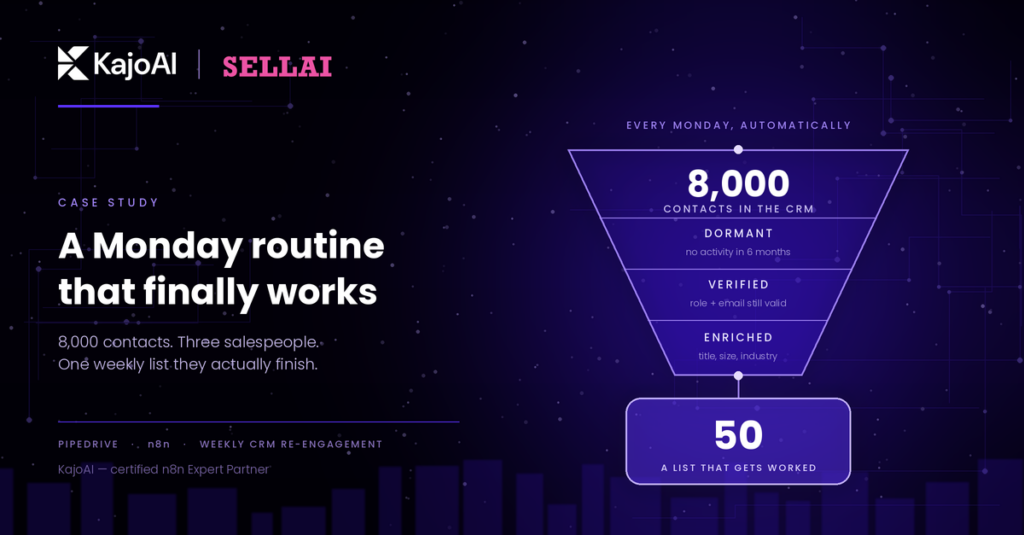
8,000 contacts, three salespeople, and a Monday routine that finally works
Customer: Sellai Oy · Stack: Pipedrive, n8n · Type: Weekly CRM re-engagement automation
The situation
Sellai’s customer database holds around 8,000 contacts. Every one of them represents a conversation somebody at Sellai already paid to start — a lead, a demo, a quote, a customer who went quiet.
Sellai has three people in sales. That is roughly 2,700 contacts each. Working through them by hand to find who is worth contacting again would take an enormous amount of time, and it is time three salespeople do not have and would rather spend selling. So the list keeps growing, and the oldest relationships quietly become the least likely to be contacted.
Contact data ages on top of that. People change roles, companies merge, email addresses stop working. A list pulled straight from the CRM sends part of the week into bounced messages and wrong job titles.
What KajoAI built
A weekly automation that runs on n8n inside Sellai’s own environment, on Sellai’s own Pipedrive credentials. Every Monday morning it does four things.
1. Finds the dormant contacts. It queries Pipedrive for people with no logged activity in the last six months and no open deal.
2. Verifies the contact is still valid. It checks whether the person still holds the role on record and whether the email address is still deliverable. Contacts that fail verification are flagged, not deleted — a person makes the final call.
3. Enriches the record. It fills the gaps in the CRM record — current job title, company size, industry — and writes the update back to Pipedrive.
4. Delivers a working list of 50. The team gets an interactive to-do list capped at 50 contacts, sized so that one week of outreach is actually realistic. The rest stay in the queue for the following Monday.
The cap is the point. Nobody acts on a list of thousands. A list of 50 gets worked.
What changed for Sellai
The weekly list arrives verified, enriched and prioritised. The sales team opens it and starts calling, instead of starting with an export and a set of manual filters.
“We have around 8,000 contacts in our database. Going through them by hand would take a huge amount of time, and with three of us in sales, that work never gets done. Now the contacts come to us verified and enriched every week as a to-do list we can actually work through.”
– Tomi Suomela, CEO, Sellai Oy
What we measure from here
Every weekly run is logged, which makes the impact measurable rather than anecdotal. Four things are tracked as the automation accumulates history:
- Contacts reviewed and re-engaged since launch
- CRM records corrected or completed
- Hours per week no longer spent building lists
- Conversations, meetings or deals reopened from the lists
Ownership
The workflow runs in Sellai’s environment on Sellai’s credentials. Every weekly run is stored with its inputs and outputs, so anyone at Sellai can open a specific Monday and see which contacts were processed, which were flagged, and what was written back. If Sellai and KajoAI stop working together, the workflow keeps running, and removing KajoAI’s access requires only one credential change.
Is this your situation?
If your CRM has more contacts than your team can ever revisit, the automation is the same shape regardless of industry.